Hardwood Failures / A diagnostic field guide
What are
you seeing?
Start with the visible condition. Compare the pattern, identify what is still unknown and prepare a useful next step.
Explore a condition ↓Open an observation record ↗VISUAL INDEX / 14 OBSERVATIONS
Find the closest visible pattern.
Diagrammatic pattern keys, not specimen photographs or diagnoses.
OBSERVE / 01
Checking
What it looks like
Short openings along the grain.
What additional information matters
Which faces are affected? Are ends or connections involved?
Keep the conclusion open
A similar appearance can have different causes. Preserve original photographs and product records before cleaning, refinishing, cutting or changing the attachment.
Potential structural, guard or connection concerns need qualified on-site assessment; a photograph cannot establish safe use.
Record this observationCompare with your photograph ↓Pattern organization is an observation aid. Technical context: USDA Wood Handbook; see the linked field guides for claim-specific sources. Reviewed September 14, 2026.
The decision follows the evidence
Observe.
Describe and preserve the condition. Monitoring is appropriate only when the responsible reviewer considers it suitable.
Address.
Resolve the cause and the applicable product guidance before choosing maintenance or correction.
Review.
Potential structural, guarding or attachment concerns require qualified assessment. A picture cannot establish safe use.
A photograph needs its context
Similar openings.
Different evidence.
These published timber inspection photographs show why a surface opening and its surrounding condition must be recorded together. They are not Ipe case studies or a do-it-yourself inspection procedure.
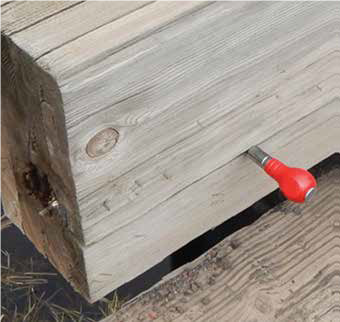
The source identifies decay-related discoloration near a split. That source finding cannot be transferred to a similar-looking board.
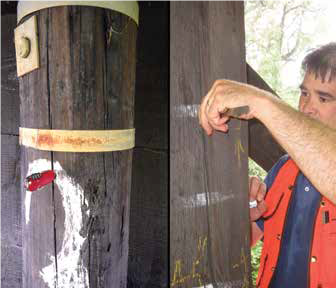
Component role, access and depth assessment are additional context. Do not reproduce this probing procedure without appropriate expertise.
Photographs: USDA Forest Service, reproduced on FHWA InfoTechnology — Probing, figures 1A and 1B. Species, site and capture date are not supplied on that page. No endorsement is implied.
Make the next conversation useful
Bring a record.
Leave the verdict open.
Location, original photographs, dated observations and material documentation are more useful than an unsupported diagnosis.
Create an observation recordHow to document the condition →Your observation / stays on this device
Look at your own material.
Open a photo beside the field categories. Choose a description and record the evidence you still need.
Your photograph will appear here.
Photo preview is local and is not uploaded or analyzed by AI. It is not retained after leaving or reloading the page.
A chosen category is a possible description, not a confirmed cause. This record does not decide defect, warranty, claim eligibility or structural safety.